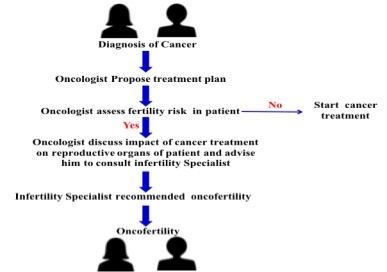
Treatment of cancer is often highly detrimental to both women and men reproductive organs and their function as follows:
|
Cancer Treatment |
Affect of Cancer Treatment on Reproductive Organs
|
 |
Chemotherapy – The degree of damage is dependent upon the type of the agent used, dose given, age of the patient and her ovarian reserve.
|
- Can damage the ovaries
- Reduce number and quality of eggs
- Cause temporary or permanent menopause
|
|
Radiotherapy – The risk of infertility will depend on the area treated and the dose. |
- May damage the reproductive organs
- Cause temporary or permanent menopause
- Chances of future miscarriage
|
|
Surgery |
- Remove the reproductive organs
- Cause scarring that impacts fertility
|
|
Hormonal therapy |
- Block the production of hormones which required for fertility
|
 |
Chemotherapy – The degree of damage is dependent upon the type of the agent used, dose given, age of the patient |
- Reduce or stop the production of sperm
- Cause genetic damage in sperm
- Reduce the motility of sperm
|
|
Radiotherapy – The risk of infertility will depend on the area treated and the dose. |
- May damage the reproductive organs or the pituitary gland, which makes hormones to trigger sperm production
|
|
Surgery |
- Effect sperm production
- The ability to get an erection and ejaculate reduce
|
|
Hormonal therapy |
- Decrease the production of sex hormone
|
Management of Oncofertility – Preserving fertility is an extremely crucial method in those cancer patients who want to start their family in future before initiation of cancer treatment. Management of oncofertility included
| Fertility Preservation Options in Women |
Fertility Preservation Options in Men |
| Embryo Freezing – Egg fertilized with sperm in laboratory and then embryo freezed to future use. (Follow IVF). |
Sperm Freezing – Harvesting and freezing of sperm. |
| Egg Freezing – Harvesting and freezing of unfertilized eggs. |
Gonadal shielding during radiation therapy – Use of shielding to reduce the dose of radiation delivered to the testicles. |
| Ovarian tissue freezing and transplantation – Freezing of ovarian tissue and reimplantation after cancer treatment. |
Testicular tissue Freezing – Freezing testicular tissue and reimplantation after cancer treatment. |
| Gonadal shielding during radiation therapy – Use of shielding to reduce the dose of radiation delivered to the reproductive organs. |
Testicular suppression with GnRH analogs or antagonists – Use of hormonal therapies to protect testicular tissue during chemotherapy or radiotherapy. |
| Ovarian transposition – Surgical repositioning of ovaries away from the radiation field. |
———– |
| Trachelectomy – Surgical removal of the cervix while preserving the uterus. |
———– |
| Ovarian suppression with GnRH analogs or antagonists – Use of hormonal therapies to protect ovarian tissue during chemotherapy or radio therapy. |
———– |
When a person is diagnosed with cancer (mainly reproductive organ cancers), he /she should consult Oncologist and Infertility Specialist. And discuss the side effects of treatment and possibilities of fertility preservation procedure. Planning of fertility preservation in advance preserve woman’s /man’s fertility until he/she has recovered from cancer and is ready to start family – sometimes years down the track.